



Maria Luiza De Grandi, Jornalist from Ciência Rural Journal, Santa Maria, Rio Grande do Sul, Brasil.
André da Rosa Ulguim, Researcher at the Department of Plant Protection, Center for Rural Sciences (CCR), Universidade Federal de Santa Maria (UFSM), Santa Maria, Rio Grande do Sul, Brasil.
 One of the greatest concerns of irrigated rice producers was highlighted in a study conducted at Universidade Federal de Santa Maria (UFSM). The work Pre-emergent herbicides during the off-season of irrigated rice to control weedy rice and reduce the soil seed bank, published in the journal Ciência Rural (vol. 55, no. 4, 2025), evaluated the effectiveness of herbicides applied in the off-season for controlling weedy rice, considered the main weed in this crop.
The research was carried out in a commercial rice production area, bringing the results closer to the conditions faced by farmers, and was part of a master’s project of the Programa de Pós-Graduação em Agronomia at UFSM. Different pre-emergent herbicides and application times were tested, seeking practical answers for management. The results showed that, although the products tested did not provide satisfactory control of weedy rice, they proved promising against other weed species present in the fields. Furthermore, applications up to 30 days before sowing did not cause injuries to the crop.
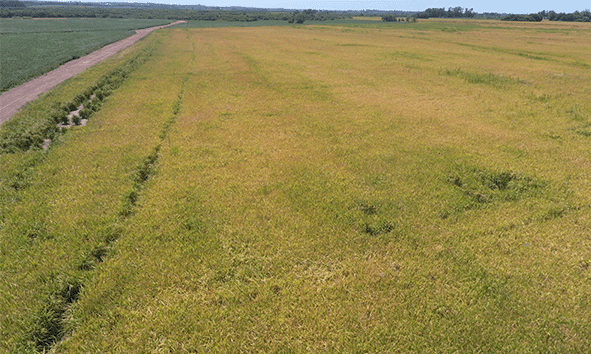
“Weedy rice is a challenge because it belongs to the same species as cultivated rice, which makes control difficult. Our research shows that some herbicides applied at this time of year may even help reduce other undesirable plants, but they should not be seen as an effective solution against weedy rice,” explains researcher André Ulguim, who supervised the study.
The innovation of the work was to evaluate not only the impact on developing plants but also on the weedy rice seed bank in the soil, the main source of field infestation. Although the tested herbicides did not significantly reduce this seed bank, the study paves the way for future research seeking more efficient alternatives.
The results provide important support for technicians and producers, helping to avoid investments in ineffective products or decisions based solely on commercial recommendations. “The great value of this research lies in providing scientific backing to field practices, allowing safer and more economical choices for producers,” reinforces André. The study also highlights the need for integrated strategies for managing weedy rice, which remains one of the greatest threats to irrigated rice production in southern Brazil.
To read the article, access
LUCAS, T.A., et al. Pre-emergent herbicides during the off-season of irrigated rice to control weedy rice and reduce the soil seed bank. Ciência Rural [online]. 2025, vol. 55, no. 4, e20240207 [viewed 18 November 2025]. https://doi.org/10.1590/0103-8478cr20240207. Available from: https://www.scielo.br/j/cr/a/53DP4kJLPQTttdk7R8SZhHk/
External links
Ciência Rural – Social Media: Twitter | Facebook | Instagram
Related Posts:



Como citar este post [ISO 690/2010]:


Recent Comments