Maria Luiza De Grandi, journalist at Ciência Rural journal, Santa Maria, Rio Grande do Sul, Brazil.
João Marcos Nacif da Costa, PhD, Universidade Federal do Rio Grande do Sul, Porto Alegre, Rio Grande do Sul, Brasil.
A group of researchers from the Laboratório Federal de Defesa Agropecuária de Minas Gerais, in partnership with the Universidade Federal do Rio Grande do Sul (UFRGS), North Carolina State University, and the Secretaria da Agricultura, Pecuária e Desenvolvimento Rural do Rio Grande do Sul, analyzed in detail two foot-and-mouth disease outbreaks that marked the country’s sanitary history in the early 2000s. The team gathered official data from that period to reconstruct the dynamics of virus spread and estimate essential epidemiological parameters to understand what differentiated the two events. The article Assessing epidemiological parameters and dissemination characteristics of the 2000 and 2001 foot‐and‐mouth disease outbreaks in Rio Grande do Sul, Brazil was published in the journal Ciência Rural (vol. 55, no. 10, 2025).
According to researcher João Marcos Costa, who is part of the group responsible for the study, these outbreaks had a huge impact on the economy and the animal health defense system, but much of the evidence generated by field investigations had never been thoroughly discussed in the scientific literature, which motivated the team to revisit these data using more modern tools. The study evaluated information on property locations, herd sizes, reporting dates, and clinical characteristics recorded during the investigations. The article describes in detail the calculations and the temporal reconstruction of the outbreaks, showing the difference between the epidemiological dynamics observed in 2000 and 2001.
João Costa highlights that “several factors contributed to the difference between the two years, such as delays in reporting, animal movement, and lower herd immunity in 2001, which created a more favorable scenario for virus dissemination.” The analyses presented in the article reinforce this interpretation by showing that, in the 2001 outbreak, the estimated case curve evolved more rapidly and with a higher number of secondary transmissions compared to the previous year.
For the researcher, revisiting these outbreaks is essential to strengthen the country’s animal health defense system. “These are events that deeply marked the sector but still lacked robust quantitative analyses. When we understand how the disease behaved in the past, we can better plan for the future,” he explains. He also emphasizes that the application of modern methods, such as Bayesian modeling, made it possible to extract important information even from old and sometimes incomplete datasets, a common limitation in historical outbreaks. The study also places the outbreaks in Rio Grande do Sul within an international context, highlighting that countries such as the United Kingdom, Argentina, and Japan already use this type of modeling to review health emergencies and improve their contingency plans.
The research helps reinforce fundamental concepts for the prevention and control of foot-and-mouth disease, such as the importance of early reporting and monitoring animal movement. João states that “every day of delay in reporting matters, and understanding its impact on real epidemics is essential for training teams, adjusting protocols, and planning emergency actions.” He also highlights that the results can be used for future scenario simulations, technical training, and the definition of biosecurity strategies for rural properties and border regions.
The work stands out for applying advanced statistical methods to historical Brazilian outbreaks, something still uncommon in the country. The researcher notes that “in Brazil, there are few studies that use quantitative tools of this kind to analyze past epidemics, and this makes our study an important step toward strengthening national veterinary epidemiology.” For him, the findings also reinforce the need to maintain investments in surveillance and prevention, especially in higher-risk regions. The researcher concludes that “looking at the past with the right tools allows us to build a more prepared and efficient animal health system.”
GRANDI, M.L. and DA COSTA, J.M.N. Differences in the transmission rate of Foot-and-Mouth Disease outbreaks in Rio Grande do Sul between 2000 and 2001 [online]. SciELO in Perspective | Press Releases, 2026 [viewed ]. Available from: https://pressreleases.scielo.org/en/2026/06/03/differences-in-the-transmission-rate-of-foot-and-mouth-disease-outbreaks-in-rio-grande-do-sul-between-2000-and-2001/



 A group of researchers from the Laboratório Federal de Defesa Agropecuária de Minas Gerais, in partnership with the Universidade Federal do Rio Grande do Sul (UFRGS), North Carolina State University, and the Secretaria da Agricultura, Pecuária e Desenvolvimento Rural do Rio Grande do Sul, analyzed in detail two foot-and-mouth disease outbreaks that marked the country’s sanitary history in the early 2000s. The team gathered official data from that period to reconstruct the dynamics of virus spread and estimate essential epidemiological parameters to understand what differentiated the two events. The article Assessing epidemiological parameters and dissemination characteristics of the 2000 and 2001 foot‐and‐mouth disease outbreaks in Rio Grande do Sul, Brazil was published in the journal Ciência Rural (vol. 55, no. 10, 2025).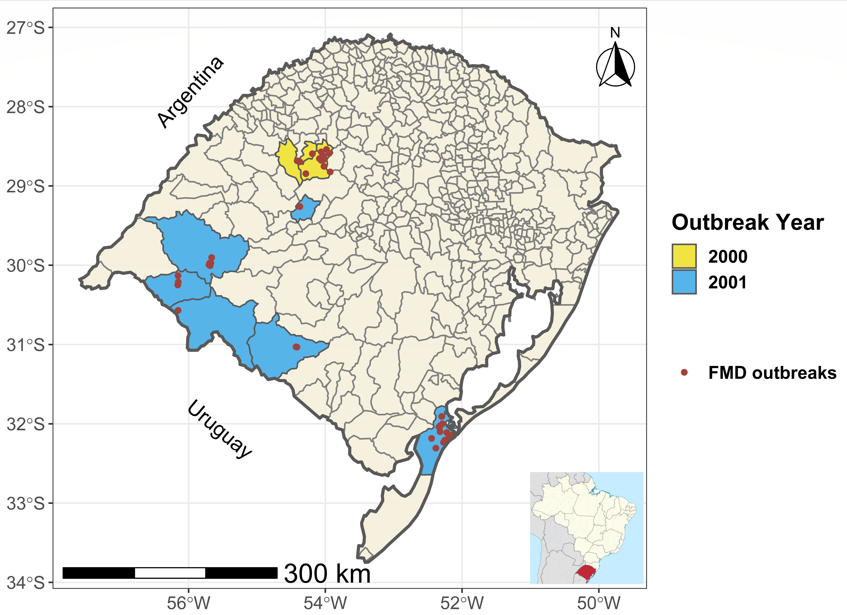








Recent Comments